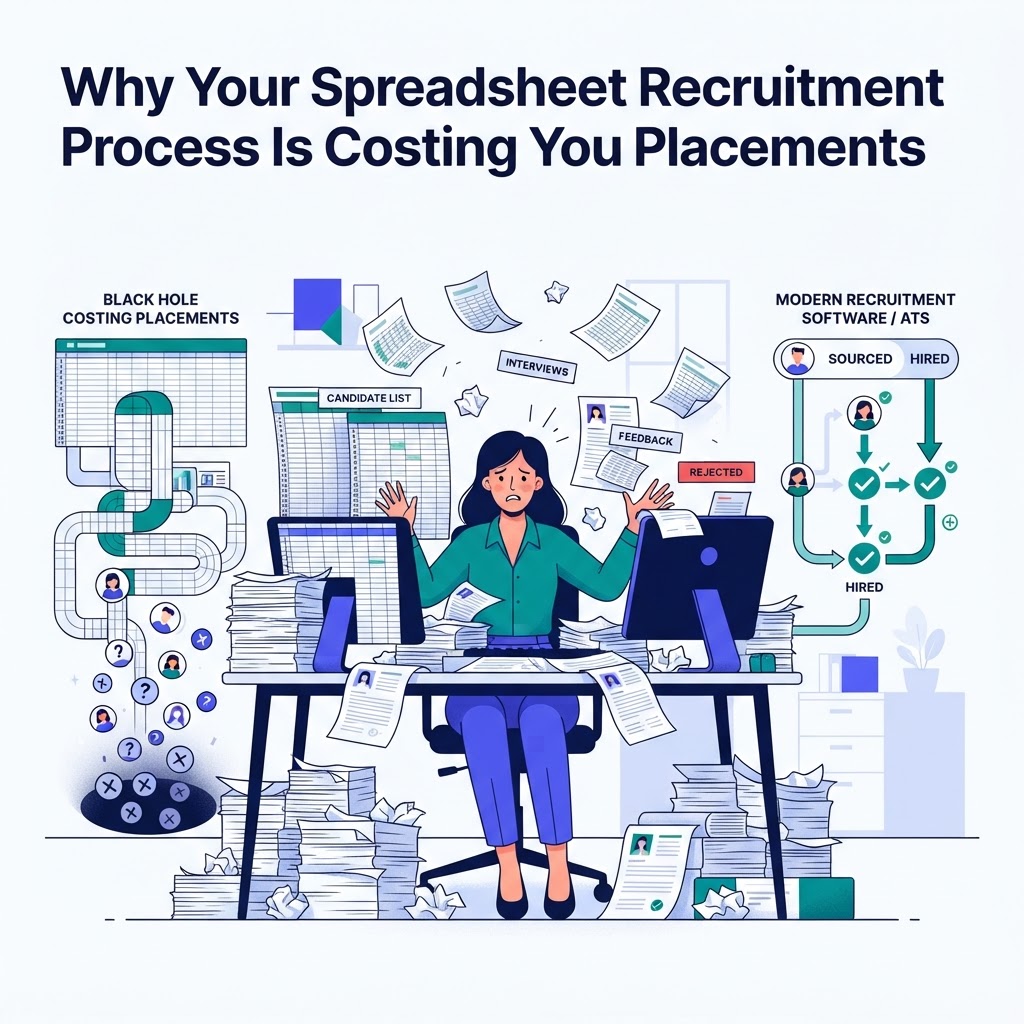
Many recruitment agencies start their journey in a simple Excel workbook. It feels manageable, customizable, and free. However, as your agency scales, that same spreadsheet that once brought clarity starts to function like a graveyard for top-tier talent. The reality of modern recruitment is that speed and data accuracy are your primary competitive advantages. When you rely on static files, you are not just working harder; you are actively losing placements because you cannot see the opportunities hiding in your own data.
The Hidden Cost of Manual Data Entry
Manual entry is the silent killer of recruiter productivity. If a team of five recruiters spends just 30 minutes a day copying data from LinkedIn or email into a spreadsheet, that is 12.5 hours of lost billing time per week. At an average agency hourly rate, this adds up to thousands of dollars in lost revenue every single month. Spreadsheets do not integrate with job boards, nor do they automate candidate parsing. Every second spent re-typing a phone number or pasting a resume URL is a second stolen from actually speaking to clients and candidates. With RecruitingCRMFlow, automated parsing and direct integrations mean you capture candidate data once and never have to touch a keyboard for administrative busywork again.
Data Fragmentation and Lost Talent
One of the biggest issues with spreadsheets is the lack of a 'single source of truth.' When multiple recruiters work off local files or shared folders, version control becomes a disaster. You might reach out to a candidate who was already rejected by a colleague three weeks ago, or worse, miss a superstar who applied to a different role but fits a current open position. This fragmentation ruins your brand reputation and confuses candidates. A CRM acts as a centralized brain for your agency. It tracks every interaction, ensuring that every recruiter sees the history, notes, and status of a candidate in real-time. You stop losing talent to internal miscommunication.
Missing the Follow-Up Window
Recruitment is a game of timing. In the current candidate-driven market, a top applicant might be off the market in less than 48 hours. Spreadsheets do not remind you to follow up. If you forget to call a client or email a candidate for a feedback update, you lose momentum. This lack of proactive tracking leads to "ghosting"—which usually happens because the recruiter simply lost track of the timeline. RecruitingCRMFlow uses automated triggers and task reminders to ensure you stay ahead of the curve. You define your workflow, and the platform ensures that no candidate sits idle for more than a few days without a touchpoint.
Lack of Insight and Reporting
How many candidates did you need to source to make your last ten placements? What is your actual interview-to-placement ratio? If you are using a spreadsheet, you likely cannot answer these questions without spending hours manually calculating totals. Without data, you are flying blind. You cannot identify which sourcing channels are yielding the best results or which clients have the longest feedback delays. A professional ATS provides instant dashboards that visualize your pipeline. You can see your conversion rates at a glance, allowing you to coach your recruiters effectively and pivot your strategy based on hard data rather than gut feeling.
Scalability and Security Risks
As your database grows, spreadsheets become prone to corruption, slow performance, and security vulnerabilities. A single deleted row or an unsaved update can wipe out weeks of work. Furthermore, spreadsheets do not offer granular access controls or GDPR compliance features, putting your agency at significant risk if data is mishandled. Moving to a dedicated CRM like RecruitingCRMFlow guarantees that your most valuable asset—your candidate list—is encrypted, backed up, and compliant with privacy regulations. It is not just about convenience; it is about building a secure foundation that allows your business to scale from ten placements a month to a hundred.
Conclusion: Making the Leap
Transitioning away from spreadsheets is not just an administrative upgrade; it is a strategic necessity for any agency that wants to compete in today’s market. The cost of maintaining a manual process far exceeds the subscription cost of a modern platform. By automating your admin, centralizing your communications, and gaining visibility into your performance, you can reclaim your time and focus on what matters: matching the right people with the right roles.