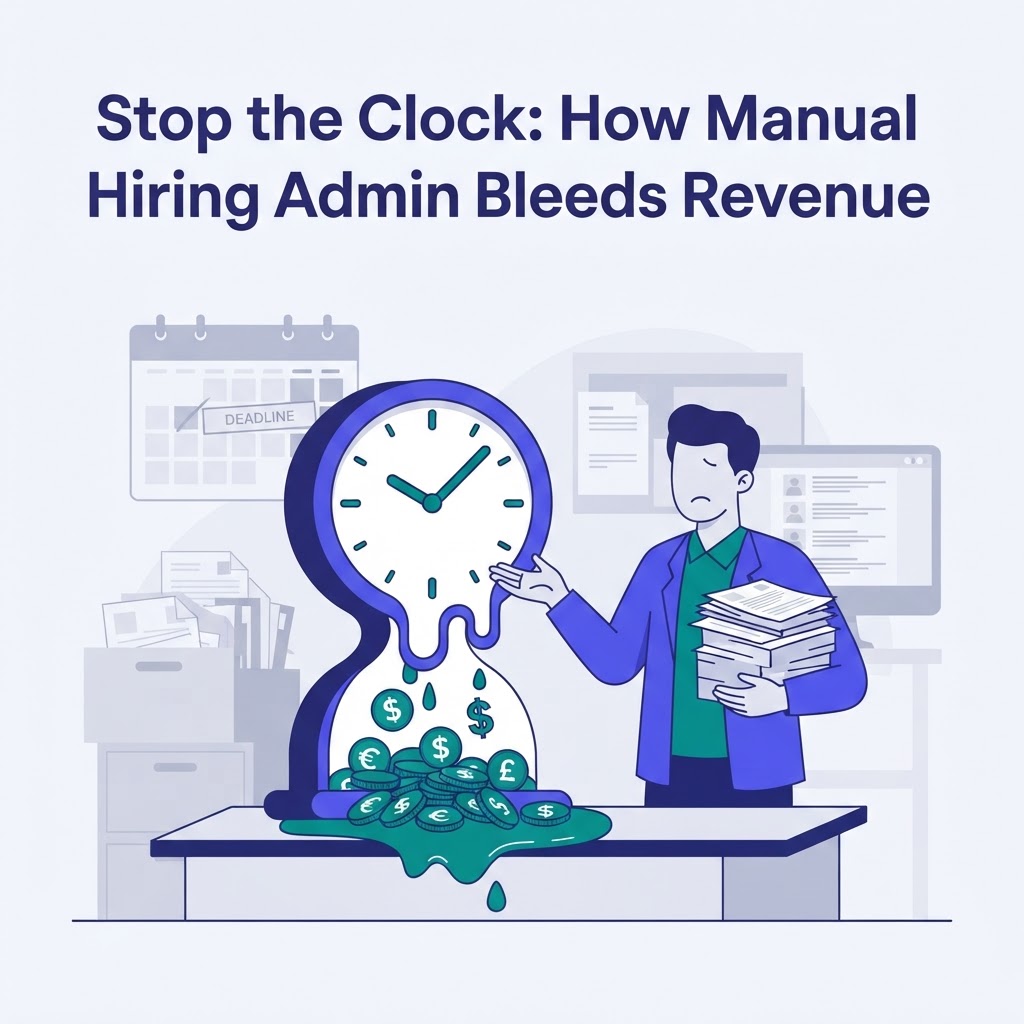
In the fast-paced world of recruitment, time isn't just a metric—it is your most valuable commodity. For many hiring teams, the workday is consumed by a relentless cycle of manual data entry, fragmented email threads, and the soul-crushing task of manually updating candidate statuses across disjointed platforms. When your recruiters spend more time battling spreadsheets than engaging with top-tier talent, your agency isn't just slowing down; it is actively losing revenue. Every hour spent on administrative drudgery is an hour taken away from building the relationships that actually close placements.
The True Cost of Administrative Drag
The math of lost productivity is sobering. Industry studies suggest that recruiters spend up to 60% of their day on non-revenue-generating administrative tasks. If you have a team of five recruiters working 40-hour weeks, that is 120 hours per week lost to manual processes. If those hours were redirected toward business development or candidate sourcing, the impact on your annual billings would be transformative. Without a centralized hub, team members often duplicate efforts, reach out to the same candidates multiple times, or lose track of high-value prospects in the chaos of disorganized inboxes.
The Silent Killer: Fragmented Candidate Data
One of the most significant time-wasters in recruitment is the absence of a 'single source of truth.' When candidate information is scattered across email, LinkedIn, and local spreadsheets, the time lost searching for the latest conversation or current status is exponential. Recruiters often lose 15 to 20 minutes every time they need to track down a candidate's history before a client interview. This lack of organization creates a poor candidate experience, as recruiters appear disorganized and disconnected. By utilizing RecruiterCRMFlow, your team consolidates every interaction into a unified candidate profile, ensuring that critical information is always a single click away.
Automation as a Competitive Advantage
Manual follow-ups and scheduling represent the largest drain on a recruiter’s bandwidth. The back-and-forth email chains involved in coordinating an interview are notorious for stalling hiring velocity. Automation changes the game by handling repetitive tasks without human intervention. By deploying smart workflows in your CRM, you can:
-
Automatically trigger candidate follow-ups after initial screeners.
-
Sync scheduling links directly to recruiter calendars, eliminating email tag.
-
Push candidate updates to stakeholders instantly, reducing manual reporting time.
When you eliminate these manual touchpoints, you shorten your Time-to-Hire significantly. Speed is a competitive edge; the faster you move a candidate through the pipeline, the less likely they are to accept a competing offer.
Maximizing ROI Through CRM Analytics
Tracking time isn't just about speed; it's about visibility. Without a CRM, identifying bottlenecks in your hiring process is largely guesswork. Do your recruiters spend too long in the sourcing phase? Is there a high drop-off rate after the first interview? RecruiterCRMFlow provides data-driven insights that highlight exactly where your team is losing efficiency. With actionable analytics, you can pivot your strategy, focus on the most productive channels, and refine your approach to coaching your team. Moving from reactive hiring to proactive, data-informed recruiting is the primary difference between hitting targets and falling behind.
Reclaiming Your Agency’s Focus
At the end of the day, your success depends on human connection, not data entry. When you implement a robust CRM, you are not just buying software; you are buying back time. This newfound freedom allows your recruiters to focus on what they do best: negotiating offers, nurturing passive candidates, and deepening client relationships. By automating the mundane, you empower your team to operate at their full potential, effectively scaling your output without necessarily increasing your headcount. The transition to a streamlined, automated workflow is the fastest route to a more profitable agency.