As we move further into 2026, the hiring landscape has shifted from a candidate-heavy market to one defined by precision and speed. Organizations that rely on 'gut feeling' interviews are finding themselves falling behind, losing top-tier talent to competitors who use data-backed, structured interview methodologies. To succeed, recruitment teams must modernize their evaluation process to eliminate bias and ensure every hire is a high-performance contributor.
The Power of Structured Interviewing
Structured interviews are no longer just a recommendation; they are a requirement for high-functioning teams. By asking every candidate the same set of questions in the same order, you create a baseline that allows for direct, objective comparison. In 2026, companies employing structured interview processes report a 35% higher correlation between interview performance and long-term job success compared to unstructured formats.
Implementing this requires a standardized scorecard. Each question should map directly to a core competency required for the role. For instance, if you are hiring a senior developer, your scorecard might measure 'Problem-Solving,' 'Code Quality,' and 'Team Communication' on a scale of 1 to 5. This removes the noise of personal charisma and keeps the focus strictly on professional capability.
Eliminating Bias Through Data-Driven Scoring
Even with structured questions, human bias remains a significant risk. Research shows that interviewers often form an opinion within the first four minutes of a conversation. By enforcing blind scoring—where recruiters or hiring managers input scores into a platform like RecruitingCRMFlow before discussing the candidate with others—you prevent the 'halo effect' from skewing results.
Utilizing a centralized system is critical here. When hiring teams collaborate inside RecruitingCRMFlow, they can aggregate scores from multiple stakeholders. If one interviewer gives a 2 and another gives a 5 for the same competency, the platform flags the discrepancy, prompting a deeper review of the candidate’s evidence rather than relying on a dominant personality to sway the hiring committee.
Leveraging CRM Tooling to Prevent Talent Leakage
One of the biggest failures in recruitment is the loss of qualified candidates due to administrative friction. If an interviewer forgets to follow up, or if feedback is siloed in an email thread, that candidate is likely to move to a competitor. In 2026, the best teams treat their candidate pool like a sales pipeline.
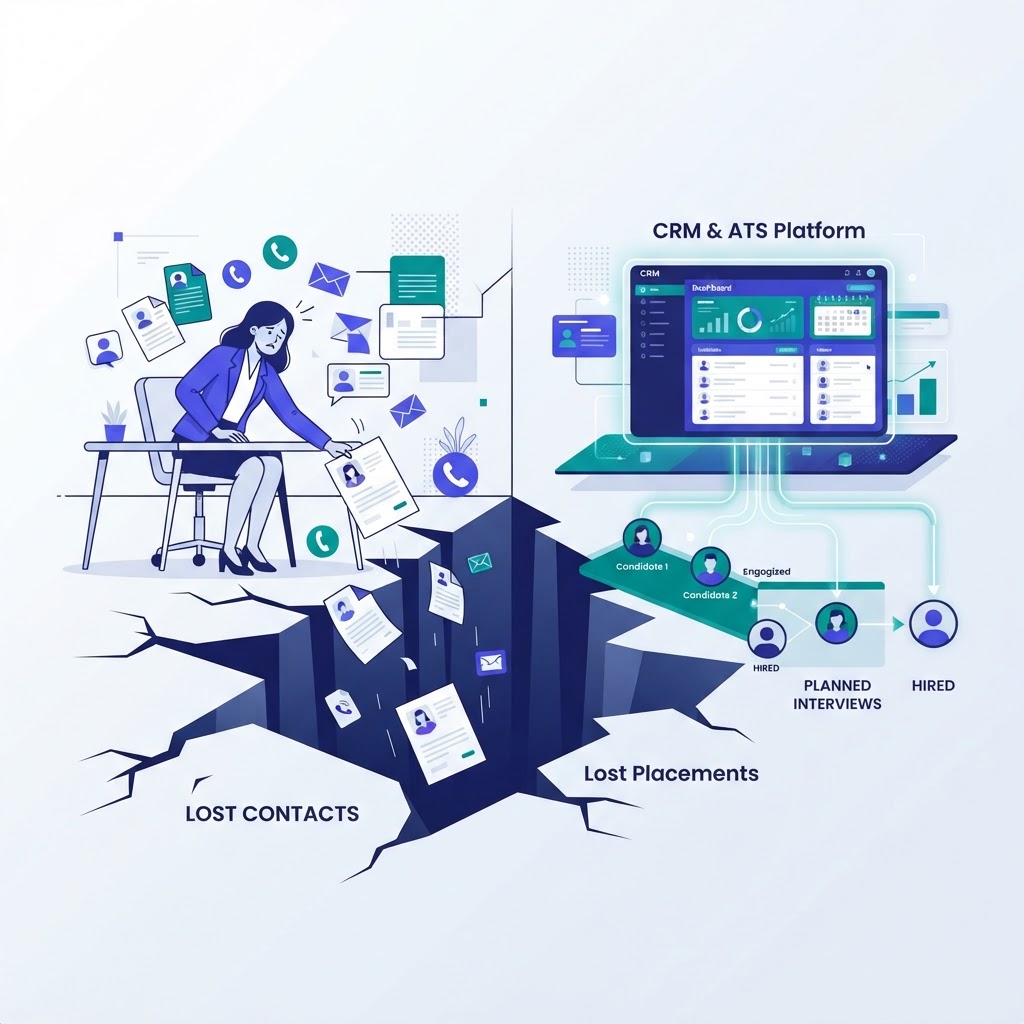
RecruitingCRMFlow acts as the single source of truth for every candidate touchpoint. When interview schedules are automated through the CRM, you ensure no candidate is left waiting for more than 48 hours. By tracking every interaction, from initial outreach to final offer, teams avoid the common pitfall of 'lost contacts'—those talented individuals who were interviewed but never re-engaged because the recruiter lost track of their status in an outdated spreadsheet.
Optimizing the Candidate Experience
Transparency is the new currency of the job market. Candidates in 2026 expect to know exactly where they stand in the hiring process. Structured interviews allow you to provide clearer expectations during the initial screening call. When a candidate understands that they will be evaluated on three specific competencies, they arrive better prepared and feel more respected by the organization.
Use your CRM to automate the post-interview experience. Send personalized follow-up emails, share company culture insights, and keep them informed of the next steps. A candidate who feels they have been treated with professional courtesy is 60% more likely to accept an offer, even if the salary is comparable to other offers.
Conclusion: Building for the Future
Modernizing your interview process requires a commitment to structure, data, and centralized tracking. By moving away from subjective, unstructured interviews and adopting a data-centric approach using tools like RecruitingCRMFlow, you minimize bias and maximize your team's efficiency. In 2026, the companies that hire best are the ones that manage their hiring process with the same rigor, technology, and analytics they apply to their revenue operations.