In the fast-paced world of agency recruiting, time is not just a metric; it is your most volatile currency. Every minute spent toggling between fragmented email inboxes, spreadsheets, and disjointed candidate databases is a minute taken away from high-value tasks like interviewing top-tier talent and closing deals. When your team spends more time managing data than managing relationships, your bottom line suffers significantly.
The Silent Drain of Manual Data Entry
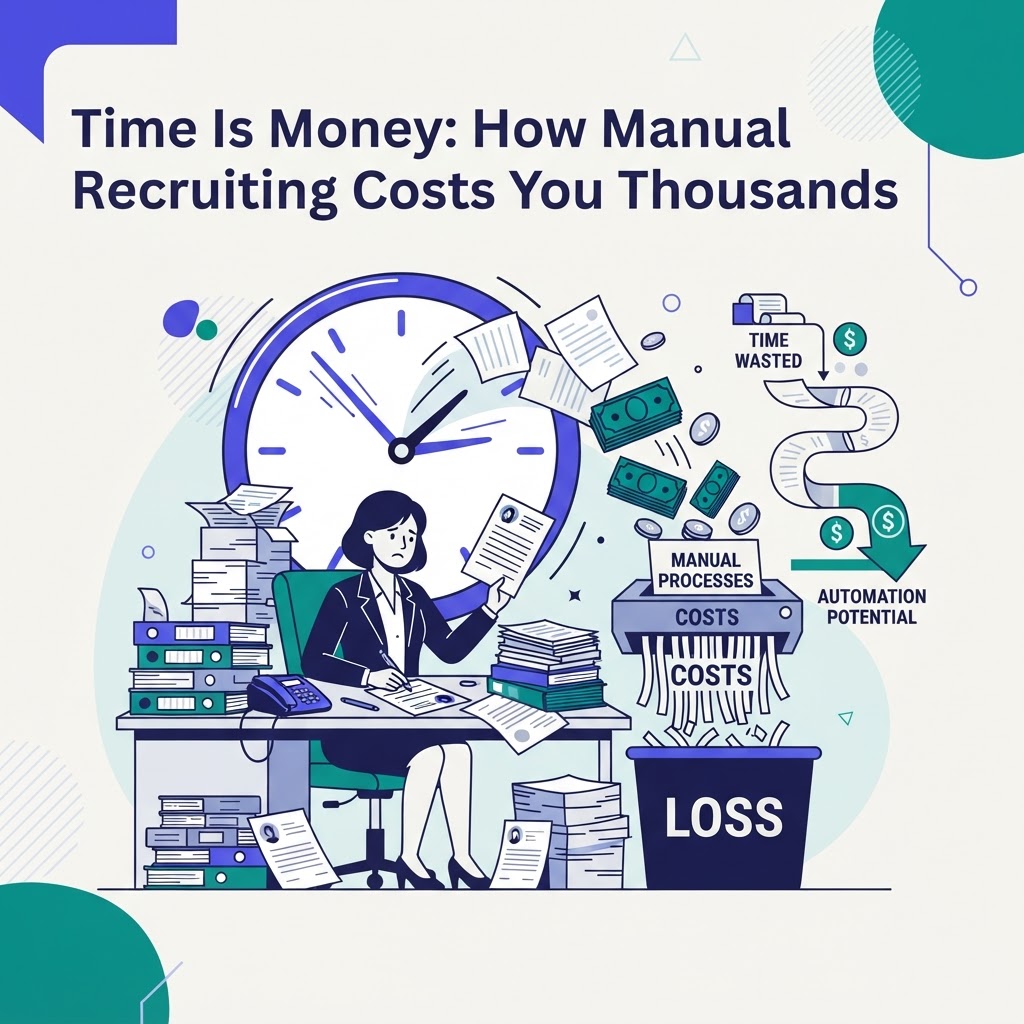
Most recruiting teams operate in a state of 'administrative drift,' where recruiters spend up to 40% of their day on low-value manual tasks. Consider the simple act of logging a call. If a recruiter spends three minutes updating a spreadsheet, sending a follow-up email, and searching for a candidate contact record after every interaction, they could easily lose two hours per day. Across a team of ten, that is 100 hours of lost billable potential per week.
RecruiterCRMFlow eliminates this friction by centralizing candidate activity. When data flows automatically into a unified CRM, the need for manual record-keeping vanishes. By reducing administrative overhead, your recruiters can refocus their energy on what actually drives revenue: conversations.
Disconnected Systems Create Information Silos
Fragmented workflows are the primary culprits behind lost talent and stalled hiring pipelines. When your ATS, email, and calendar tools do not communicate, recruiters inevitably find themselves searching for updated contact info or scouring sent folders for past communication threads. This context switching breaks flow and delays critical feedback cycles.
Without a single source of truth, teams often suffer from 'candidate ghosting'—not because they don't care, but because they have lost the thread in the chaos. RecruiterCRMFlow ensures that every interaction, document, and interview note is indexed against a candidate profile, allowing your team to pick up exactly where they left off without losing a beat.
Accelerating the Hiring Cycle with Automation
Automation is the difference between a high-performing agency and one that struggles to scale. Manual scheduling is perhaps the most notorious time-killer in the recruitment lifecycle. Back-and-forth emails to align interview times between hiring managers and candidates can take days, often resulting in losing candidates to faster-moving competitors.
By leveraging the automated scheduling features integrated into RecruiterCRMFlow, you strip away the administrative back-and-forth. Candidates can select times that work for them from a real-time calendar view, instantly updating your CRM and triggering the necessary notifications. This efficiency can shorten the 'time-to-interview' metric by 30% or more.
Nurturing Talent Pools for Long-term ROI
Many agencies treat candidates as transactional entities, resulting in a high cost of acquisition every time a new role opens. Without a CRM to track the long-term history of candidate engagement, you are forced to start from scratch for every search. This is a massive waste of resources.
A robust CRM acts as an asset-building machine. By tracking relationships over time, RecruiterCRMFlow allows you to:
-
Identify passive candidates who might be ready for a move.
-
Automate email sequences to keep your agency top-of-mind.
-
Segment your database by niche skills, seniority, or industry.
-
Maintain visibility into historical interactions, even if a recruiter leaves the agency.
Turning Time Back into Revenue
Ultimately, the value of a CRM isn't just in the software; it is in the time recovered. When you subtract three hours of busywork from a recruiter's daily routine, you are effectively adding three hours of pure sales activity. Over a quarter, this translates to dozens of extra candidate placements and a significant boost in agency revenue.
Stop paying for manual work. Start investing in a system that tracks your progress, automates your tedious admin, and keeps your team focused on winning. With the right infrastructure, your agency can stop chasing the clock and start dominating the market.