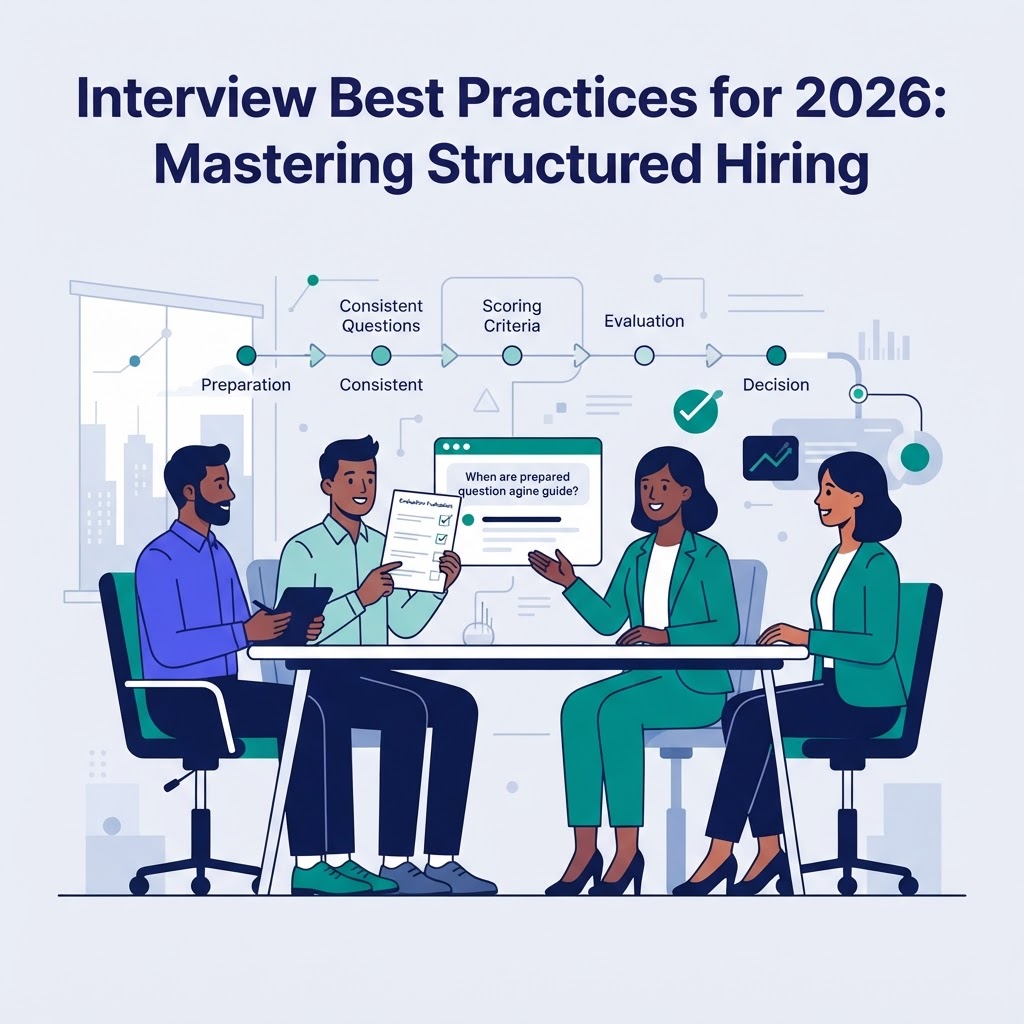
The landscape of talent acquisition has shifted dramatically as we move through 2026. The days of relying on gut feelings and unstructured conversations are officially behind us. Today, hiring teams that leverage structured interviews, data-driven scoring, and integrated CRM technology are seeing a 40% increase in long-term employee retention compared to those using legacy methods.
The Rise of Structured Interviews
Structured interviews involve asking every candidate the same set of questions in the same order. This uniformity is the single most effective way to eliminate unconscious bias and ensure that you are comparing apples to apples. Research indicates that structured interviews are twice as predictive of future job performance as unstructured interviews. By establishing a consistent baseline, you prevent the 'halo effect,' where a recruiter might favor a candidate simply because they share a common hobby or alma mater, rather than evaluating actual technical competencies.
Implementing Weighted Scoring Rubrics
To move beyond subjective evaluations, hiring teams must adopt quantitative scoring rubrics. A successful rubric breaks down specific role requirements into key competencies, such as problem-solving, communication style, or technical proficiency. Each interviewer should score these traits on a scale of one to five immediately following the interview. Without this documentation, recall bias takes over; within 48 hours, interviewers typically forget 30% of the specific details of a conversation. By standardizing these scores, your team creates a quantifiable dataset that makes hiring decisions objective and auditable.
Leveraging CRM Tooling for Candidate Intelligence
One of the most significant pitfalls in modern hiring is the 'silo effect.' When candidate notes, interview feedback, and scorecards live in disconnected spreadsheets or emails, valuable talent intelligence is lost. This is where RecruitingCRMFlow becomes essential. By centralizing the entire interview process within a dedicated recruiting CRM, your team ensures that no data point is left behind. When interviewers use RecruitingCRMFlow to input scores and feedback in real-time, the platform aggregates this data, allowing hiring managers to view a comprehensive 'candidate health' profile at a glance. This prevents the loss of top-tier talent who might otherwise fall through the cracks due to internal communication delays.
Optimizing the Candidate Experience
In the 2026 market, candidates act more like consumers than ever before. A slow, disorganized hiring process is a major red flag that signals poor company culture. By using an ATS with integrated scheduling features, you can reduce the time-to-interview by up to 60%. Automated workflows in RecruitingCRMFlow allow recruiters to trigger follow-up emails, share interview prep guides, and provide transparent status updates. When a candidate feels respected by a streamlined, professional process, they are 25% more likely to accept a job offer even when competing offers are on the table.
Reducing Time-to-Fill with Data-Driven Decisions
Without a unified platform, hiring managers often spend hours chasing down feedback from interview panels. RecruitingCRMFlow solves this by automating the feedback loop, sending reminders to interviewers, and forcing the completion of scorecards before a candidate can progress to the next stage. This reduction in administrative overhead allows recruiters to focus on what actually matters: building relationships with high-quality candidates. By tracking metrics like 'time-per-stage' within your CRM, you can identify exactly where your funnel is stalling and fix the bottlenecks before they result in lost opportunities.
Conclusion: The Future is Integrated
As we look further into 2026 and beyond, the competitive advantage will belong to organizations that treat recruitment like a high-precision science. By implementing structured interviews, maintaining rigorous scoring rubrics, and utilizing a robust CRM like RecruitingCRMFlow to track the entire lifecycle, you eliminate guesswork. Do not let your best prospects slip away because of disorganized data or slow communication. Start modernizing your interview framework today to build the high-performing teams of tomorrow.