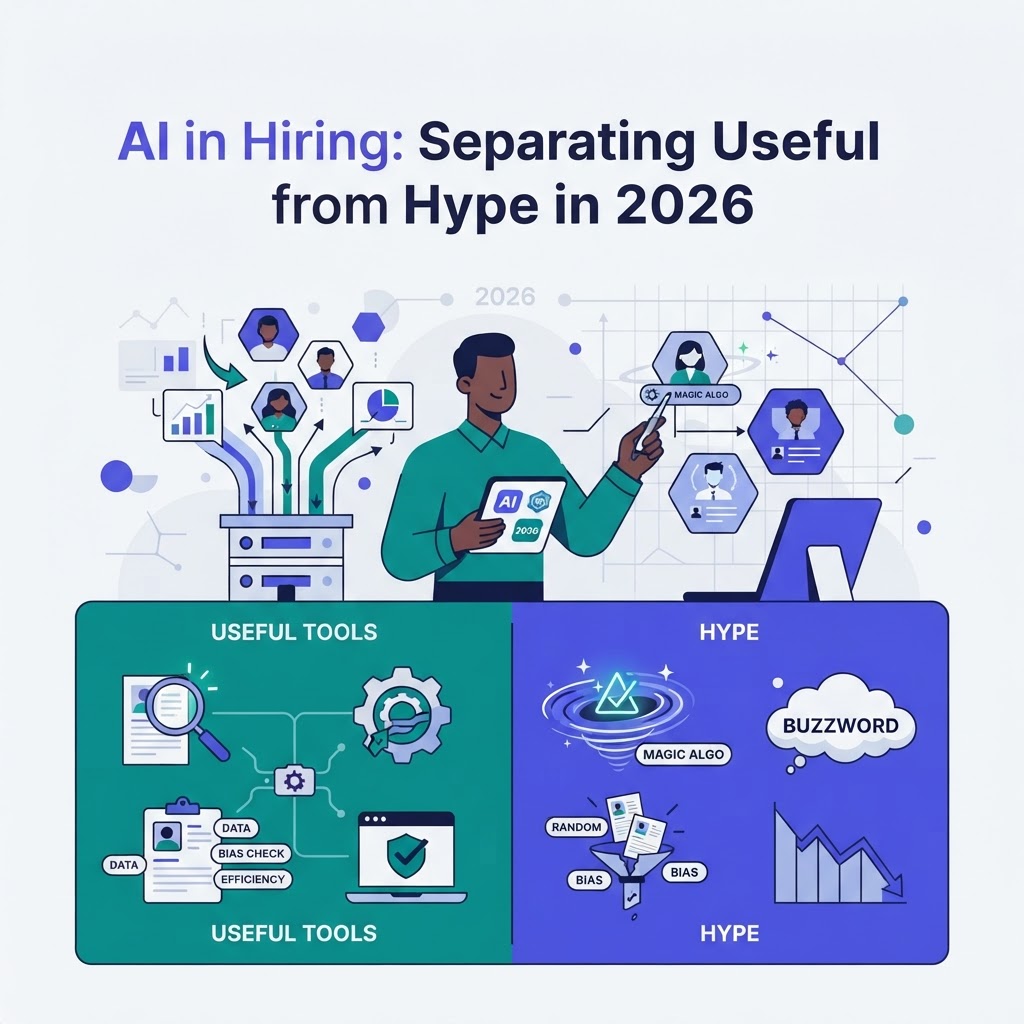
As we navigate the landscape of 2026, the recruitment industry has moved past the 'AI gold rush' phase. While early adopters were dazzled by generic LLM prompts, modern recruiters now demand tangible ROI. The distinction between a high-utility AI tool and mere marketing hype is no longer about how 'intelligent' a model sounds, but how well it integrates into your existing workflow to minimize administrative drag and maximize placement velocity.
The Evolution of Intelligent CV Parsing
Traditional CV parsing tools were once rigid, relying on keyword density that often resulted in false negatives. By 2026, AI-driven semantic parsing has fundamentally changed the game. Instead of looking for exact matches for 'Java developer,' modern parsers interpret the context of a candidate's career progression, project scope, and soft skills. When these parsers are embedded directly into a platform like RecruiterCRMFlow, they allow recruiters to populate candidate profiles without manual data entry, saving an average of 15 minutes per high-quality lead. The signal of real value here is the ability to map unstructured data from a PDF into structured, searchable CRM fields, ensuring no candidate data is trapped in a silo.
Matching Algorithms vs. Predictive Analytics
Many vendors claim their AI can 'predict' top performers. However, the most useful tools focus on high-fidelity matching rather than dubious predictive scoring. Effective matching technology evaluates a candidate's historical performance, technical stack evolution, and industry tenure against specific job descriptions. The hype is in the 'personality prediction' algorithms that lack scientific backing; the utility is in the matching engine that surfaces passive candidates who have been dormant in your database. Without a robust CRM, this data remains buried. RecruiterCRMFlow centralizes these matches, turning your forgotten legacy database into an active pipeline of pre-qualified talent.
CRM AI: Beyond Automated Emails
Generic AI email tools are now table stakes. The true differentiator in 2026 is contextual relationship management. The most effective AI features in a CRM now act as a personal assistant, summarizing communication history and suggesting the perfect moment to re-engage a candidate based on market trends or their specific employment tenure. If your CRM cannot tell you which candidates you haven't spoken to in six months who are now 'open to work' based on public data updates, you are leaving revenue on the table. RecruiterCRMFlow utilizes these insights to ensure recruiters never lose touch with their network, preventing the 'lost talent' phenomenon that plagues high-volume agencies.
Avoiding the 'Black Box' Trap
Transparency is the final filter for separating hype from necessity. If a tool acts as a 'black box'—where it suggests a candidate but cannot explain why—you risk bias and inefficiency. High-value tools in 2026 provide 'explainability.' They show you why a candidate was ranked #1 based on specific criteria. When selecting your tech stack, prioritize platforms that allow for human-in-the-loop oversight. You should be able to audit the AI's logic, ensuring that your hiring process remains equitable and compliant with emerging 2026 labor regulations.
Building a Future-Proof Tech Stack
To succeed, you must avoid the trap of 'tool fatigue.' Adding ten disparate AI plugins often creates more manual work than it solves. The most successful recruiters consolidate their operations into a single source of truth. By using RecruiterCRMFlow, you integrate AI parsing, automated matching, and intelligent relationship tracking into one interface. This reduction in context switching leads to a measurable increase in candidate reach-outs—often by as much as 40%—because the platform handles the administrative heavy lifting.
In 2026, the goal of AI should be to make recruiting more human, not less. By choosing tools that enhance your database utility and remove the friction of data entry, you reclaim time to focus on what actually drives placements: building relationships. Stop chasing the hype and start investing in the infrastructure that makes your data work for you.