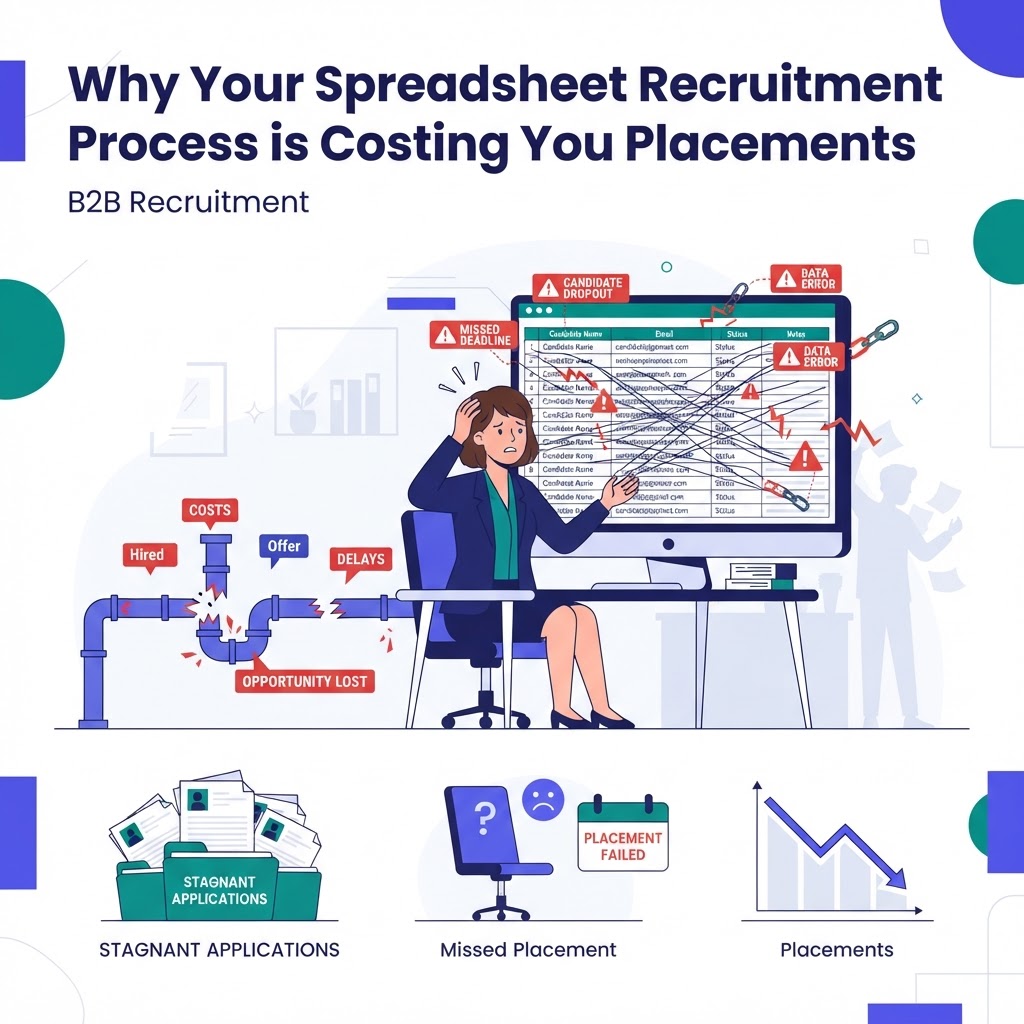
Many recruitment agencies begin their journey with a simple set of spreadsheets. They are free, familiar, and seemingly straightforward. However, as your candidate pipeline grows, the friction caused by manual data entry becomes a bottleneck that actively suppresses your revenue. Choosing between a recruiting CRM vs spreadsheet is not just about tools; it is about choosing between stagnation and scalable growth. In this article, we explore the hidden costs of manual tracking and why a dedicated platform is the ultimate investment for your agency.
The True Cost of Manual Recruitment Tracking
On the surface, a spreadsheet costs nothing but your time. But time is the most expensive commodity in recruitment. Consider a recruiter who spends two hours a day manually updating statuses, chasing candidate emails, and searching through fragmented columns. If that recruiter earns $50 per hour, you are losing $500 per week—or $24,000 per year—in lost productivity alone. This is the invisible tax of manual data management. When you compare a recruiting CRM vs spreadsheet, you have to factor in the opportunity cost of these lost hours that could have been spent on client development or candidate interviews.
Why Spreadsheets Are Scaling Killers
Spreadsheets lack the automation necessary to compete in a high-speed market. As your database grows to 5,000 or 10,000 candidates, simple tasks become agonizingly slow. Furthermore, spreadsheets are prone to human error. A misplaced row, a broken filter, or a forgotten update can lead to duplicate entries and missed opportunities. These errors do not just frustrate your team; they damage your reputation with candidates who may receive duplicate outreach or, worse, never hear back at all. Without a centralized database that triggers automated workflows, your team is destined to fall behind competitors who are using data-driven insights to fill roles faster.
Centralizing Your Talent Pipeline with RecruiterCRMFlow
This is where RecruiterCRMFlow changes the game. By centralizing your entire ecosystem, RecruiterCRMFlow eliminates the 'spreadsheet chaos' by providing a single source of truth. Every interaction, email exchange, and status update is logged automatically. Our platform allows your team to visualize their pipeline, automate follow-ups, and generate advanced analytics that spreadsheets simply cannot touch. By automating the administrative burden, RecruiterCRMFlow frees up your recruiters to do what they do best: build relationships and place top-tier talent.
Data Integrity and Security Requirements
Recruitment is a data-heavy industry, and with global privacy regulations like GDPR and CCPA, keeping candidate data in a local spreadsheet is a compliance disaster waiting to happen. Spreadsheets do not provide robust audit trails, encrypted storage, or automated data deletion workflows. A recruiting CRM vs spreadsheet debate should always factor in risk management. A dedicated CRM provides granular permission controls and secure cloud storage, ensuring that you remain compliant while protecting the sensitive personal data of your candidates. Protecting your data is not just a 'nice to have'; it is a necessity for long-term survival.
Converting Data into Actionable Intelligence
Spreadsheets are excellent for static reporting, but they fail at real-time intelligence. When a client asks for a performance update, do you have to spend hours formatting a report? A dedicated CRM turns raw data into actionable insights instantly. You can track metrics like 'Time-to-Hire,' 'Conversion Rate by Source,' and 'Recruiter Productivity' at the click of a button. These insights allow you to identify which sourcing channels are yielding the best talent and where your funnel is leaking. Investing in a CRM pays for itself by providing the clarity needed to optimize your business strategy daily.
Conclusion: Making the Transition to a Professional CRM
While spreadsheets served their purpose in the early days of your agency, they are ultimately anchors slowing down your performance. The transition from a recruiting CRM vs spreadsheet mindset is a necessary evolution for any recruiter serious about growth. By eliminating the manual drag, ensuring regulatory compliance, and unlocking deep analytical insights, a platform like RecruiterCRMFlow becomes a profit driver rather than an expense. The cost of a CRM is often lower than the 'hidden' salary cost of just one week of manual data entry. Stop managing your agency through cells and start growing it through intelligent automation.