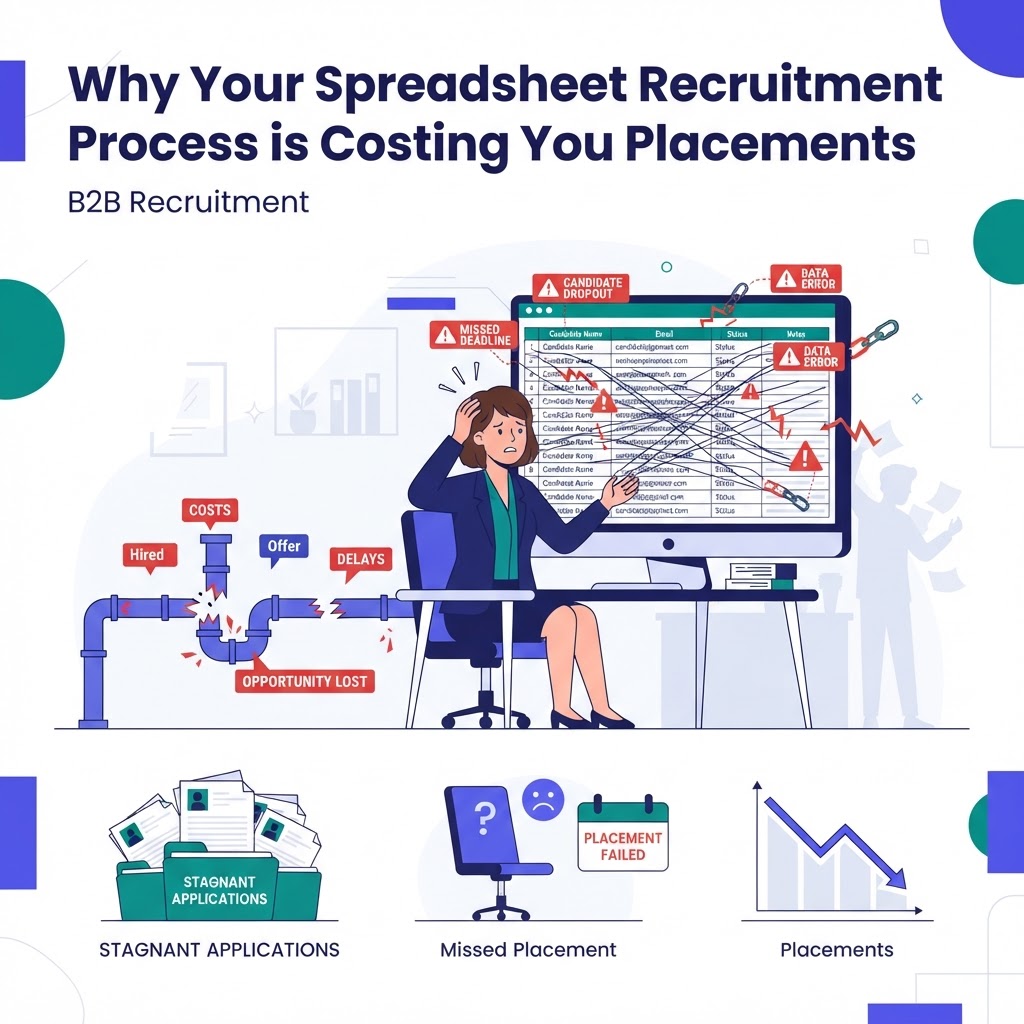
In the fast-paced world of recruitment, speed is the currency of success. Yet, many agency owners and individual recruiters still rely on the humble spreadsheet as their primary applicant tracking system. While a grid of columns might feel organized during your first five placements, it quickly becomes a fragile house of cards as your candidate pipeline grows. This manual dependency is not just a productivity bottleneck; it is a direct contributor to lost revenue and missed opportunities in a competitive market.
The Hidden Cost of Manual Data Entry
Every minute spent manually updating a spreadsheet is a minute you aren't talking to high-value candidates or closing new business. If you handle 20 applications a day and spend three minutes per entry, you are losing one hour every single day to data administration. Over a year, that equates to roughly 260 hours of billable time sacrificed to manual entry. When you account for an average recruiter hourly rate, this isn't just lost time—it is thousands of dollars in unrealized agency revenue. RecruitingCRMFlow eliminates this friction by automating data capture, allowing you to focus on the human side of hiring.
Data Fragmentation and Lost Talent
Spreadsheets are notorious for becoming silos of information. When your candidate data lives in isolated files rather than a centralized, searchable database, you lose the ability to perform complex talent mapping. Have you ever missed an opportunity because you couldn't instantly filter for a candidate's specific certification, salary expectation, or availability? In a spreadsheet, unless you have meticulously tagged every cell, that candidate effectively disappears once they are hidden in a scrollable list. A modern CRM ensures that your entire talent pool is a searchable asset, not a graveyard of outdated contact info.
The Risk of Lack of Visibility
Without a proper ATS, you lack the real-time analytics required to optimize your funnel. Do you know your exact conversion rate from first contact to interview, or from offer to placement? Spreadsheets fail to visualize the velocity of your pipeline. If you don't know where the drop-off happens, you cannot fix it. Using a platform like RecruitingCRMFlow provides automated dashboards that reveal precisely where your process is stalling. If you can see that 60% of your candidates are stalling at the reference check stage, you can pivot your strategy immediately.
Client Relationships and Communication Decay
Recruitment is inherently relational. If a client calls you about a specific role, they expect an immediate status update on their shortlist. If you have to spend ten minutes digging through email threads and cross-referencing your spreadsheet tabs, you lose your professional edge. Worse, manual systems often lead to duplicate reach-outs or, conversely, letting a top-tier candidate go stale because there were no automated reminders set to follow up. CRM systems track every interaction, ensuring your outreach is timely, personalized, and never repetitive.
Scalability vs. The Spreadsheet Ceiling
There is a glass ceiling for any agency that relies on static files. Once you reach a certain volume of roles, the probability of human error—such as overwriting data, broken formulas, or missing updates—increases exponentially. When you are ready to scale your team, spreadsheets become impossible to manage across multiple users. A cloud-based recruitment CRM provides a single source of truth that grows with your business, allowing you to onboard new recruiters into a pre-structured, efficient workflow immediately.
Ultimately, the transition from spreadsheets to a dedicated recruitment CRM is about reclaiming your time and professionalism. By reducing administrative load, gaining deep visibility into your pipeline, and ensuring no talent falls through the cracks, you turn your recruitment process into a scalable engine for growth. It is time to stop spreadsheet-tracking and start managing your agency for the success it deserves.