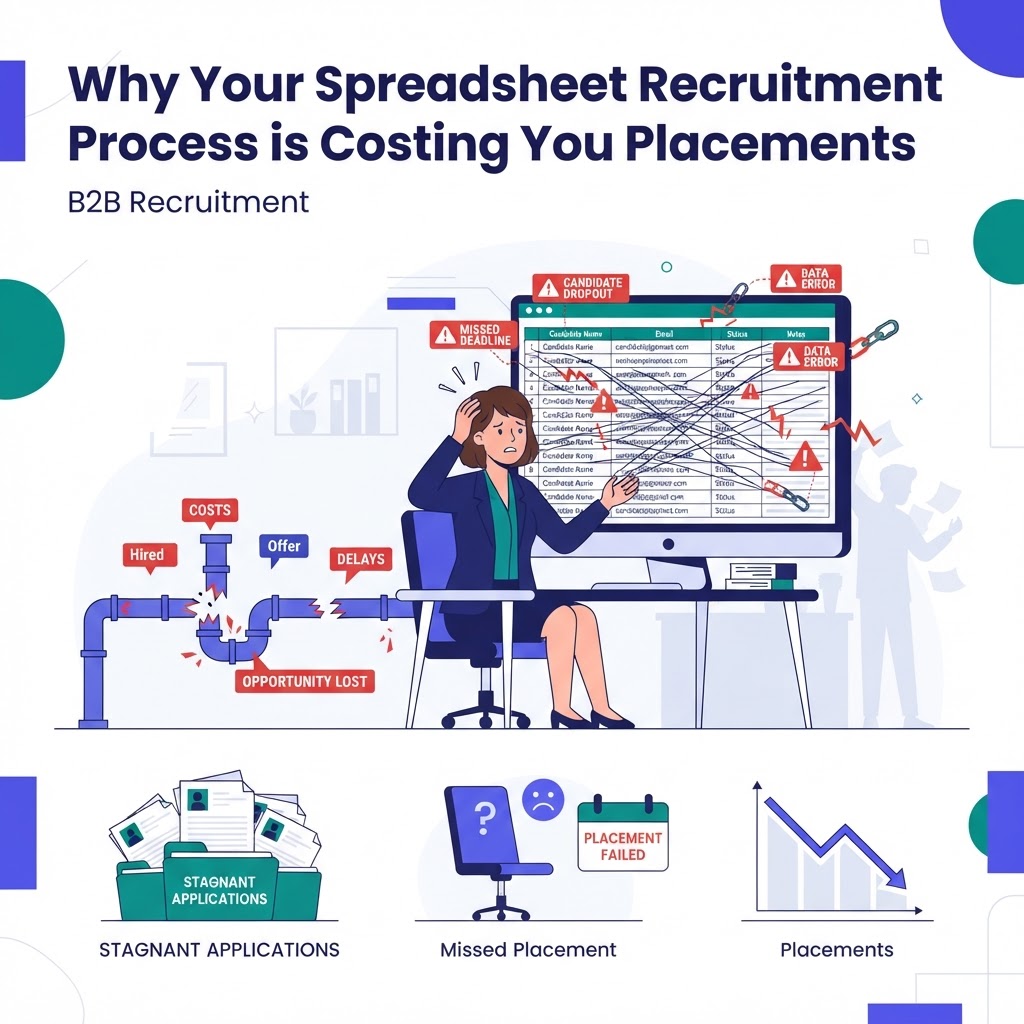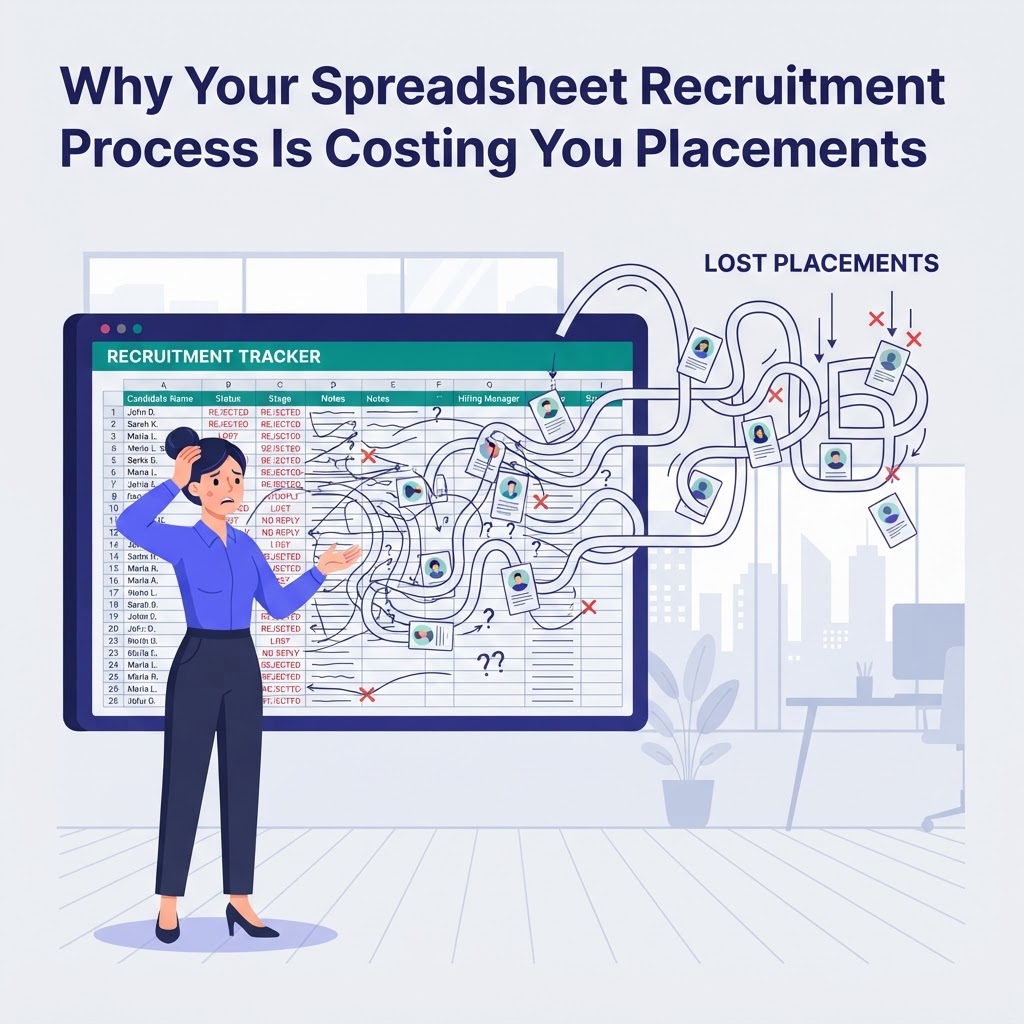
Many recruitment agencies begin their journey with a simple spreadsheet. It is free, familiar, and seemingly organized. However, as your agency scales, that rows-and-columns approach transforms from a helpful tool into a significant bottleneck. When your database becomes a sprawling web of static cells, your ability to react quickly to the market diminishes, directly impacting your bottom line.
The Hidden Cost of Manual Data Entry
The primary danger of relying on spreadsheets is the time leak caused by manual administration. If your recruiters spend two hours a day updating candidate status, formatting resumes, or cross-referencing contact info, you are losing approximately 500 hours per recruiter annually. At an average billable rate of $150 per hour, that is $75,000 in lost productivity per head. RecruitingCRMFlow eliminates this friction by automating data capture, allowing your team to focus on the high-value activity of building relationships instead of data hygiene.
Data Fragmentation and Lost Candidates
Spreadsheets are notorious for creating 'data silos.' When information lives in individual files on local machines, it becomes impossible for your team to maintain a single source of truth. If a candidate emails a consultant who is on vacation, and that interaction isn't logged in a centralized ATS, the opportunity is often lost. With a platform like RecruitingCRMFlow, every touchpoint—from the initial LinkedIn message to the final offer letter—is tracked in a shared environment. This ensures that no candidate falls through the cracks, regardless of which consultant is handling the account.
The Lack of Real-Time Analytics
Effective recruitment requires a data-driven approach to pipeline management. Spreadsheets make it incredibly difficult to track KPIs like time-to-hire, source-of-hire, or submittal-to-placement ratios. Without these insights, you are essentially flying blind. A specialized CRM provides visual dashboards that allow managers to see exactly where bottlenecks occur. If you notice that candidates are stalling at the interview stage, you can pivot your strategy immediately. Spreadsheets simply cannot offer this level of granular, actionable intelligence.
Security and Compliance Risks
Managing candidate personal information in spreadsheets poses a significant security threat. GDPR and other privacy regulations demand strict control over how PII (Personally Identifiable Information) is stored and processed. Excel sheets lack robust permission structures, audit logs, and automated data deletion protocols. Using a purpose-built system like RecruitingCRMFlow ensures that your agency remains compliant, protecting both your reputation and your business from costly legal penalties associated with data breaches.
Scaling Complexity Beyond Cells
As your candidate pool grows into the thousands, Excel performance degrades. Searching for 'the best Java developer in Chicago' across twenty separate sheets is a recipe for frustration. Recruitment CRMs are designed to handle complex relational data. With advanced filtering, Boolean search capabilities, and tag-based categorization, finding the perfect match becomes a task that takes seconds rather than hours. This speed is often the deciding factor in securing a placement before a competitor does.
Conclusion: Moving Toward Efficiency
The transition from spreadsheets to a professional ATS might feel daunting, but the cost of inaction is far higher. Every placement lost to a slow process or a forgotten candidate is revenue directly out of your pocket. By investing in a centralized system like RecruitingCRMFlow, you transform your recruitment process from a reactive, manual chore into a proactive, scalable engine for growth.