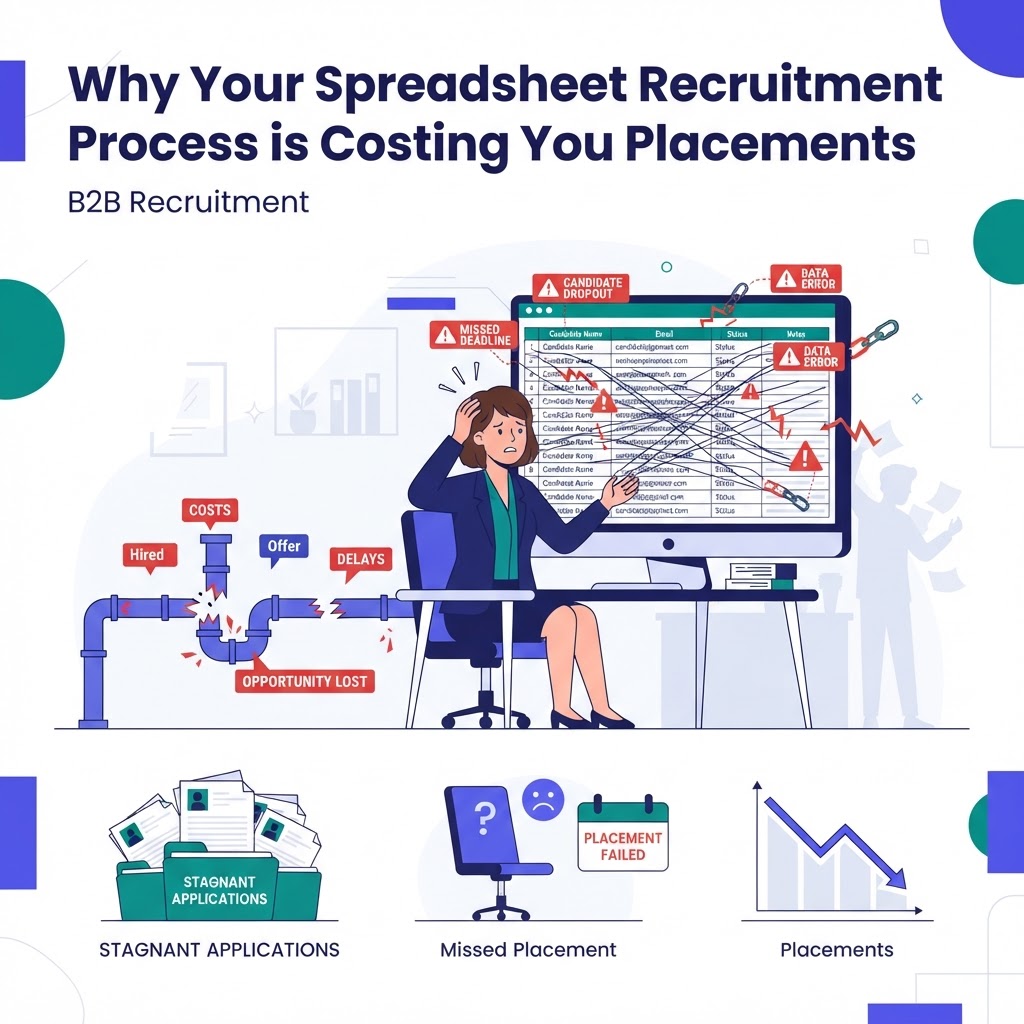
For many boutique recruiting agencies, the humble spreadsheet is where it all begins. It is easy to set up, requires no budget, and provides a familiar interface for tracking candidate status. However, as your agency scales, the very tool that helped you start becomes the primary obstacle to your success. What feels like organization is often just a static graveyard for potential placements, masking the true cost of inefficiency.
The Illusion of Control and the Cost of Manual Data Entry
When you manage recruitment via Excel or Google Sheets, you are essentially performing data entry rather than recruitment. Every time you manually update a candidate's status, copy-paste a phone number, or log an interaction, you lose valuable minutes that could be spent building relationships. If your recruiters spend just 30 minutes a day on manual data entry, that equates to over 120 hours per year, per person. In an industry where speed-to-market is the ultimate competitive advantage, that time represents thousands of dollars in lost commission opportunities.
The Hidden Cost of Candidate Ghosting
Spreadsheets are notorious for making candidates invisible. Without automated reminders, follow-ups, or nurture sequences, it is incredibly easy for a qualified prospect to slip through the cracks. In a spreadsheet, a candidate is just a row. In a dedicated platform like RecruiterCRMFlow, a candidate is a living profile with a history of engagement. Without a CRM, you lack the triggers that notify you to reach out when a candidate goes silent. When you fail to nurture a prospect, they do not wait for your spreadsheet to remind you—they sign with a competitor who stays top-of-mind.
Data Fragmentation and Institutional Amnesia
One of the most dangerous aspects of spreadsheet-based recruiting is data fragmentation. When your candidate data lives in isolated files on a laptop or a shared drive, you lack a "single source of truth." If a recruiter leaves your agency, they often take their "black book" of contacts with them, or worse, leave behind a mess of cryptic notes that nobody else can decode. This is institutional amnesia. A CRM acts as a centralized repository, ensuring that every interaction, note, and document is preserved as company intellectual property, regardless of staff turnover.
Why Speed-to-Market Matters
In modern recruitment, the first agency to present a vetted candidate often wins the placement. Spreadsheets are static by design; they do not alert you when a candidate is updated, nor do they help you search your database effectively. RecruiterCRMFlow allows you to filter and segment your talent pool instantly. Instead of scanning rows to find a niche skill set, you can run a query to identify top-tier candidates who have already been vetted. This reduction in search time can be the difference between filling a role in three days versus three weeks.
Scaling Without Losing Your Personal Touch
As your candidate pipeline grows, spreadsheets inevitably become bloated and slow. Loading times increase, formatting breaks, and the potential for human error skyrockets. You cannot automate the human touch, but you can automate the administrative burden. By migrating to an integrated platform, you free your team to focus on the high-value activities—negotiating offers, preparing candidates for interviews, and networking with new clients. Scaling your agency requires a foundation that grows with you, not a tool that forces you to limit your volume to maintain sanity.
Conclusion: Moving Beyond the Row and Column
If you are serious about increasing your placement volume, it is time to move past the spreadsheet. The "cost" of a CRM is an investment that pays for itself through reclaimed time, better candidate retention, and centralized knowledge. Don't let your process define your limits. Use a purpose-built tool like RecruiterCRMFlow to track what matters, automate the mundane, and focus on what really makes a recruiter successful: human connection.