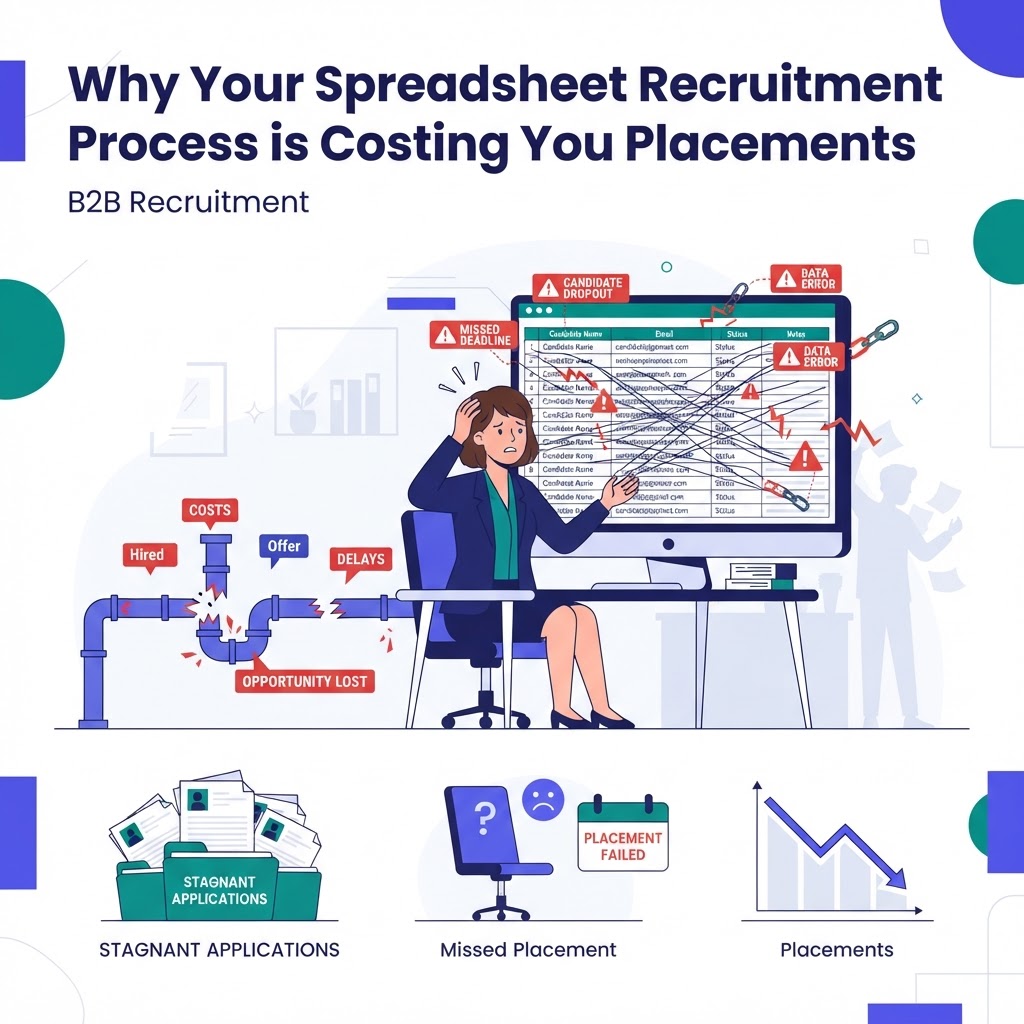
In the early days of a recruiting firm, a simple spreadsheet often feels like a masterstroke of efficiency. It is free, familiar, and easy to format. However, as your candidate pool expands and your client list grows, that static document transforms from a useful tool into a significant bottleneck. When you rely on rows and columns to track human relationships, you are essentially gambling with your commissions.
The Silent Drain on Your Billable Hours
Manual data entry is the primary thief of your recruiting productivity. Consider a recruiter who spends two hours a day updating statuses, copying email threads into cells, and manually searching for contact history. At a modest billing rate of $100 per hour, that recruiter is costing the firm $1,000 per week in lost potential. Over a year, this adds up to over $50,000 in lost billable time just on administrative busywork. RecruitingCRMFlow eliminates this by automating candidate record updates and syncing directly with your inbox, allowing you to focus on headhunting rather than data entry.
The Cost of 'Lost' Candidates
Spreadsheets lack the inherent intelligence required to manage the modern candidate lifecycle. When a candidate is buried in row 452 of a spreadsheet, they become invisible. If a new job opening appears that matches that candidate’s skill set, you are unlikely to remember them unless you manually scan your entire database. This results in 'candidate decay,' where top-tier talent moves on to a competitor simply because you couldn't effectively surface them. A robust ATS like RecruitingCRMFlow uses smart tagging and advanced search functionality to ensure that no candidate profile ever goes cold, surfacing the right people the moment a requisition opens.
Missing the Window for Passive Talent
Passive candidates are the lifeblood of high-end recruiting, but they require consistent, long-term nurturing. Spreadsheets are notoriously bad at reminders and automated follow-ups. If you forget to check in with a top-tier candidate for three months, you have lost your competitive edge. With a CRM, you can automate touchpoints and set activity reminders that ensure you remain top-of-mind. The hidden cost of a 'missed check-in' is often the loss of an exclusive placement, which could have been worth tens of thousands of dollars in agency fees.
Collaboration Silos and Duplicate Efforts
In a team environment, spreadsheets create massive operational friction. When multiple recruiters work off the same file, version control becomes a nightmare. Have you ever double-pitched a candidate to a client, or reached out to a contact that a colleague already spoke with? These 'collision errors' destroy your brand reputation and make your agency look unprofessional. RecruitingCRMFlow acts as a single source of truth, providing real-time visibility into every interaction. When your team has a shared view of the truth, you stop competing against each other and start collaborating to close deals faster.
Why Real-Time Analytics Matter
If you can’t measure your recruitment pipeline, you cannot improve it. Spreadsheets provide a snapshot, but they rarely offer actionable insights into your conversion rates. An integrated platform allows you to identify exactly where candidates are dropping off in your funnel. Are you spending too much time interviewing candidates who never make it to the client? Without a CRM, you are essentially flying blind. Using RecruitingCRMFlow, you can track metrics like time-to-fill and submission-to-interview ratios, giving you the hard data needed to optimize your strategy.
Taking the Next Step
Moving away from spreadsheets isn't just about 'getting organized'; it is about protecting your bottom line. Every placement you lose to a competitor because of a tracking error or a forgotten follow-up is money left on the table. By migrating to a purpose-built solution like RecruitingCRMFlow, you trade static rows for dynamic intelligence, ensuring your agency operates with the speed and precision that today’s market demands.